Genetic Mutations What Mistakes Can Occur When Dna Is Replicated?
nine.5: Deoxyribonucleic acid Mutations
- Page ID
- 35716
What yous'll larn to practise: Recognize the impact of DNA mutations
A mutation is a permanent amending in the DNA sequence that makes up a factor; that is, the sequence differs from what is found in most people. Mutations range in size; they can affect anywhere from a single Deoxyribonucleic acid building cake (base pair) to a large segment of a chromosome that includes multiple genes. Gene mutations tin exist classified in two major ways:
- Hereditary mutations are inherited from a parent and are present throughout a person'south life in virtually every jail cell in the body.
- Acquired (or somatic) mutations occur at some fourth dimension during a person's life and are nowadays only in certain cells, non in every cell in the body.
Mutations tin impact an organism in both negative and positive ways—and sometimes a genetic mutation doesn't impact the organism at all!
Learning Objectives
- Empathise what a mutation is and how one by and large occurs
- Identify the major types of Deoxyribonucleic acid mutations
What is a Mutation?
Over a lifetime, our Dna can undergo changes or mutations in the sequence of bases: A, C, G and T. This results in changes in the proteins that are fabricated. This can be a bad or a good thing.
A mutation is a change that occurs in our Dna sequence, either due to mistakes when the Deoxyribonucleic acid is copied or as the upshot of environmental factors such as UV light and cigarette fume. Mutations can occur during DNA replication if errors are made and not corrected in time. Mutations tin besides occur as the result of exposure to environmental factors such as smoking, sunlight and radiation. Often cells can recognize any potentially mutation-causing impairment and repair it before it becomes a fixed mutation.
Mutations contribute to genetic variation within species. Mutations can likewise be inherited, peculiarly if they occur in a germ cell (reproductive egg or sperm). Mutations that have a positive consequence are more likely to be continually passed on. For example, the disorder sickle cell anaemia is acquired past a mutation in the gene that instructs the building of a protein chosen hemoglobin. This causes the red blood cells to become an abnormal, rigid, sickle shape. Nonetheless, in African populations, having this mutation also protects against malaria.
However, mutation can also disrupt normal gene activity and cause diseases, like cancer. Cancer is the most common human genetic disease; it is acquired by mutations occurring in a number of growth-controlling genes. Sometimes faulty, cancer-causing genes can exist from birth, increasing a person'southward gamble of getting cancer.
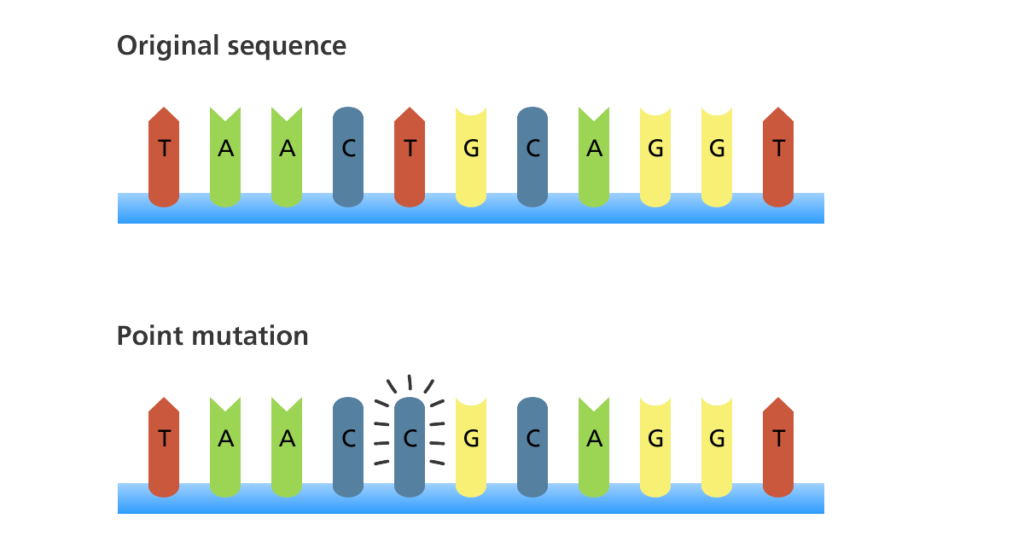
Major Types of Mutations
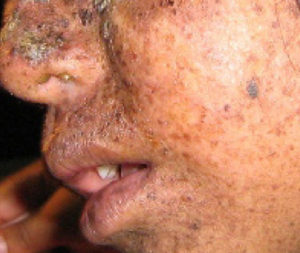
A well-studied example of a mutation is seen in people suffering from xeroderma pigmentosa (Figure ii). Affected individuals have skin that is highly sensitive to UV rays from the sunday.
When individuals are exposed to UV, pyrimidine dimers, especially those of thymine, are formed; people with xeroderma pigmentosa are not able to repair the damage. These are not repaired because of a defect in the nucleotide excision repair enzymes, whereas in normal individuals, the thymine dimers are excised and the defect is corrected. The thymine dimers distort the structure of the Deoxyribonucleic acid double helix, and this may crusade issues during DNA replication. People with xeroderma pigmentosa may have a higher run a risk of contracting skin cancer than those who don't have the condition.
Errors during Dna replication are not the only reason why mutations arise in Deoxyribonucleic acid. Mutations, variations in the nucleotide sequence of a genome, tin can also occur considering of damage to Deoxyribonucleic acid. Such mutations may be of 2 types: induced or spontaneous. Induced mutations are those that result from an exposure to chemicals, UV rays, ten-rays, or some other ecology amanuensis. Spontaneous mutations occur without whatsoever exposure to any environmental agent; they are a result of natural reactions taking place within the trunk.
Mutations may have a broad range of furnishings. Some mutations have no impact on an organism; these are known as silent mutations. Signal mutations are those mutations that affect a single base pair. The well-nigh mutual nucleotide mutations are substitutions, in which one base is replaced by some other. These tin exist of two types, either transitions or transversions. Transition commutation refers to a purine or pyrimidine existence replaced past a base of the aforementioned kind; for instance, a purine such as adenine may be replaced past the purine guanine. Transversion substitution refers to a purine being replaced past a pyrimidine, or vice versa; for example, cytosine, a pyrimidine, is replaced past adenine, a purine. Mutations can besides be the result of the addition of a base of operations, known every bit an insertion, or the removal of a base, also known as deletion. Sometimes a slice of Deoxyribonucleic acid from one chromosome may get moved to another chromosome or to another region of the aforementioned chromosome; this is as well known as translocation.
Mutations in repair genes have been known to crusade cancer. Many mutated repair genes take been implicated in certain forms of pancreatic cancer, colon cancer, and colorectal cancer. Mutations tin affect either somatic cells or germ cells. If many mutations accumulate in a somatic cell, they may lead to problems such as the uncontrolled cell division observed in cancer. If a mutation takes place in germ cells, the mutation will exist passed on to the side by side generation, as in the case of hemophilia and xeroderma pigmentosa.
The Causes of Genetic Mutations
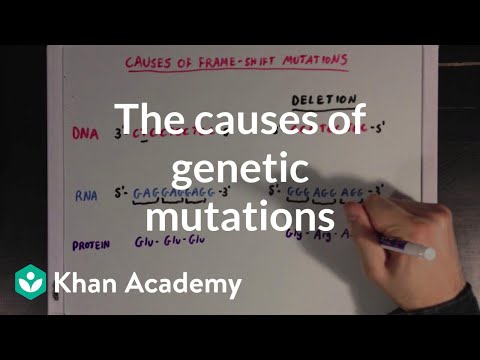
A YouTube element has been excluded from this version of the text. You tin view it online here: pb.libretexts.org/biowm/?p=182
Learning Objectives
DNA polymerase can make mistakes while adding nucleotides. Most mistakes are corrected, but if they are non, they may result in a mutation defined every bit a permanent alter in the DNA sequence. Mutations tin be of many types, such equally substitution, deletion, insertion, and translocation. Mutations in repair genes may atomic number 82 to serious consequences such as cancer. Mutations can exist induced or may occur spontaneously.
Bank check Your Understanding
Respond the question(south) below to see how well y'all understand the topics covered in the previous section. This short quiz does not count toward your grade in the form, and you lot can retake it an unlimited number of times.
Utilize this quiz to bank check your understanding and decide whether to (1) report the previous section further or (2) movement on to the side by side section.
https://assessments.lumenlearning.co...sessments/6901
0 Response to "Genetic Mutations What Mistakes Can Occur When Dna Is Replicated?"
Post a Comment